Thursday, June 29, 2017

They Called her Audrey: A Hurricane Survival Story , by Rita Monette


Sixty years ago, my family survived a devastating hurricane in Cameron, Louisiana...They called her Audrey 

by Rita Monette


Here are the memories of an eleven-year-old of that event:
Story by Rita Monette


It was late afternoon on June 27, 1957. My sister and I were playing in the yard with our ballerina dolls we’d gotten for Christmas the year before. Mama hollered for us from the back door and told us to get our things inside. The radio had said there was a hurricane in the Gulf of Mexico, and it was predicted to hit land in a day or so. But since we lived right on the Gulf, we might get some rising water ahead of it. 


My dad and my brother headed out to the lake to get their crab lines pulled in. We waited for Dad to get home to tell us how bad it was and if we’d have to evacuated. The sun went down and my dad and brother were still not home. I fell asleep on my small bed with the window open, enjoying the unusually cool July breeze that made the curtains billow across my bed. 


I awoke with Mama shaking me, telling me we had to get out, the water was rising fast, and the hurricane seemed to be getting closer.

This was during the days when hurricanes were not tracked as easily. They also were not given categories. Audrey in retrospect was a level five, and came ashore pushing a tidal wave and over a hundred mile-an-hour winds.


“Daddy said the water's rising," she told us. "He's gone to the courthouse to find out if it being used as a shelter. He’ll be back in a little while to get us,” she told us.

While waiting for Dad to come back for us, we helped Mama put things on the tops of the beds and tables so they wouldn’t get wet if the water came into the house. I wanted to take my doll, but she said it would be safe on top of her bed with the rest of the things she wanted to save, such as family photos and documents.


By the time Dad got back home, the water was creeping into the living room. With one last look back at my doll, I stepped carefully down the four plank steps feeling the lukewarm water wash against my legs, then soak into my clothes. The tide had apparently risen several feet since my dad had left, causing him to have to leave his car and come for us on foot. Mama carried my one-year-old brother, and we all held hands to stay together against the current that kept pulling at us. It was dark. Rain was falling at a steady pace. The water covered everything so that it was hard to see or feel where the edge of the road was,  but Dad lead the way, treading through the water that was waist-deep to me. The push of the waves was so strong it was hard to stand. As we got closer to town and the courthouse, it was more shallow, until finally at the top of the court house steps, it was dry. The entrance of the big stone building was filled with other people that had already found their way to safety. The steps did not stay dry very long, as huge waves begin to roll in.

Although Dad said he didn't think the water would get much higher, he took us to the third floor where it was less crowded. Mama laid the blanket she had wrapped around my baby brother on the floor in the hallway. We all used that as our “space,” while others claimed theirs. Before the night was over, all three floors had been filled with the inhabitants of the small fishing town of Cameron.


A chill went through me as my damp skirt still clung to my legs. I sat with my knees pulled against my chest and wiggled my bare toes. “Mama I’m hungry.”

“The water will be down in a little while, and we can go back home,” she assured me.

I looked around. Some of the others had brought baskets of food. I wondered why my parents hadn’t thought of that. 

Me and my younger brother and sister decided to explore the courthouse, telling Mama we wouldn’t be very far away. We spent the next hour exploring, going up and down the stairs. We found an area that was filled with little glass boxes with tiny babies in them. Apparently they had been born too early. We were swiftly shooed away.


We went into a big room with a giant desk and lots of benches. We decided that was the judge's desk.  People had already made a bed on top of it, which I thought was kind of disrespectful at the time. Some people were sprawled out on the long benches that looked like pews. We saw a woman lying on one, screaming, clutching her prayer beads in her hands while tearing at her blouse.  I wondered why she was so upset. We'd been through hurricanes before. We were safe here. Daddy said so.

I don't remember feeling scared. At eleven, I didn't fully understand the power of wind and water. After all, we knew our dad would not let anything bad happen to us.

An announcement came that everyone was to evacuate the first floor.  The water was still rising. We knew Mama was on the third, so we scurried up the stairs ahead of the crowd of terrified people. 

As the daylight approached. Police officers were going up to all of the men and requesting they give up their cigarette lighters and matches due to propane tanks, torn from their lines by the rising water, gas no doubt escaping. They said the tanks may blow up if they were too close to the building and a flame. My dad asked Mom to hide his lighter and cigarettes, promising us that he wouldn't light them up until after it was safe.


As the day progressed, the water began sloshing up onto the stairway to the second floor. We played a game of seeing how long we could sit on a step before the water would chase us up to a higher one. We would go back and report to Mom that the water was coming up fast, not realizing that we were feeding into her fear, that she no doubt tried to hide from us kids.

With people beginning to crowd onto the third floor, there was more panic. It was getting stuffy and smelly. Bathrooms overflowed, and those that had to go, went where they could. 

People gathered at the large glass windows, wringing their hands, and murmuring or crying. We joined them to see what was happening outside, and saw houses floating by with people on the roofs screaming and shouting for someone to help them. No one watching could save them. They floated away, some being swept into the raging water, trying to hang on to whatever they could grab. We watched as the muddy water rushed further and further in from the Gulf, taking debris from crushed houses, downed trees, and propane tanks with it. Police officers urged people to stay away from the windows. The fear and panic around me began to sink into my chest.  Were we really safe? What about all those people that needed help and no one to help them? How much longer can the wind blow and the water rise?

The day went on and the storm surged on, wind howling and windows breaking from things flying against them, Some people screamed in fear. but my dad and my mom stayed outwardly calm, probably for us kids. I don’t know if either one of them ate at all that day. My baby brother had a bottle that was now empty. The three of us kids had gathered a few chips and cookies that people had given us from their own baskets. We munched on those, while Mom and Dad refused to take any. 

It began to get dark again, but the electricity in the courthouse had long since gone out. We huddled in our little spot throughout the night listening to the wind as it howled. An occasional tiny light appeared as someone took their chances with the gas leaks and lit up a cigarette.


As daylight appeared through the window, people started moving around, some gathering at the windows to see what was going on. The winds had quieted down and the water had stopped rising. By midday, you could begin to see the horrible site the waters and winds had left behind. The water started to recede as fast as it had come in.

Mama got up and went to the window for the first time. She spotted our house and called us to look. Sure enough there was a house upside down on the street in front of the courthouse, Mom's hand-made lime-green curtains flapping in the wind.

Daddy was gone, and we went to look for him. We found him on the first floor with a group of people that were coming into the building. They had the most terrified look on their faces. Some looked like ghosts. Some were crying uncontrollably. I listened as they blurted out their stories. Some talked about spending the storm in a tree, clinging to their families, some of which had been swept away. I saw my uncle and some of my cousins. They had spent the storm in a two-story farm house outside of town. A rescue squad had gone out and rescued them and brought them to the one intact building in Cameron. The court house. Five hundred men, women, and children are said to have lost their lives that day.


Dad and a group of men left to go out looking or more survivors and food for their families. They came back later that day with cans of food. He opened a can of beans with his knife and handed it to me. I ate it with my dirty fingers. It was the best tasting pork and beans I’d ever eaten.

Dad had also gone into our upside-down house and found the refrigerator right side up. Apparently it had floated upright due to being sealed. A glass gallon jug of milk sat intact on one of the shelves. My baby brother had milk for his bottle.

The following morning, we were escorted out of the court house in a long trail that had been laid with boards in order to keep people from stepping on power lines or boards with nails in them. We went single file to the river where we got on tug boats that took us to Lake Charles, a town a little higher up. We were herded into a school stadium that was lined with army cots, where we were fed hot soup and fresh cold water.


After listening to some of the survivors' stories, of being surprised by the tidal wave storm in the middle of the night, I became grateful that my dad, being a fisherman on the lake that day, anticipated what was coming out on the Gulf, and got us to shelter before our house got swept away and us drowned. 

For everyone Audrey touched that day, it changed their lives forever. And for years after, those that survived measured time by before, during, or after the hurricane.
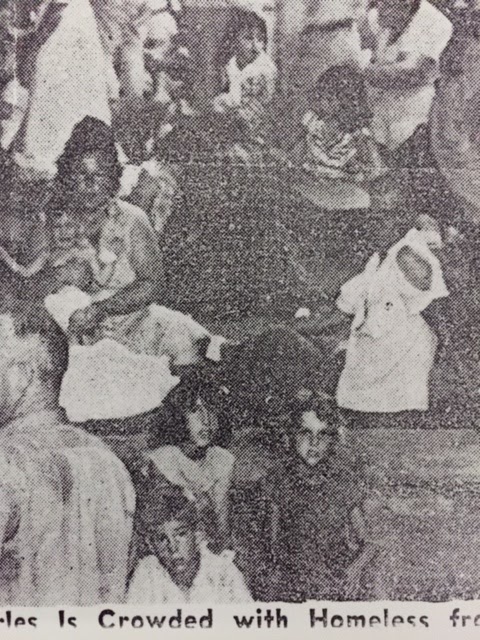


The photo left is from a New Orleans newspaper, snapped at the arena where we were taken after leaving the courthouse. Mama had told us to look up at the cameraman so that Grandma, who lived in New Orleans, would see it and know that we were alive. 

Pictured are Mom holding my baby brother, Dad to the right of her, me, my sister, and brother up front. 

Thursday, May 4, 2017

Boudreaux & Thibodeaux, and the disappearing candy bars


Louisiana Tidbit


Boudreaux and Thibodeaux (Boudreaux being the dumbest one of the two) are two Cajuns that, from as far back as I can remember, are the epitome of Cajun humor.  Here's one I thought I'd share as a Louisiana tidbit for the day. 

     Thibodeaux and Boudreaux entered a chocolate store. As they were looking at the candy, Thibodeaux stole three chocolate bars. 
     When they left the store Thibodeaux said to Boudreaux, "I'm da best thief ever. I stole three chocolate bars and no one saw me put dem in my pocket. You can't beat dat."
     Boudreaux replied, "You want to see somet'ing better? Let's go back to da shop and I'll show you real stealing. I'll steal while da shopkeeper is
watching me, and he won't even know."
     So they went to the counter and Boudreaux said to the shopkeeper, "Do you want to see a great magic trick?" 
     The shopkeeper replied, "Yes."       
     Boudreaux said, "Give me three chocolate bars." 
     The shopkeeper gave him three
chocolate bars, and Boudreaux ate all three. 
     The shopkeeper asked, "But where's the magic?"
    To which Boudreaux replied, "Look in Thibodeaux's pocket."

Tuesday, March 28, 2017

Crawfish Boils, by Rita Monette


 Louisiana Crawfish Boils

by Rita Monette

It’s springtime! The time when folks begin to gather outdoors for barbeques and cookouts. But if you live in Louisiana, family and friends usually crowd together for crab and crawfish boils.

Growing up in Louisiana, there wasn’t a weekend that went by when at least one family member would invite us over for a boil! It was a time when cousins played on the lawn, and the women sat around and gossiped, while the men worked around the hot pots, purging the crawfish, seasoning the water (everyone had his own recipe as to what went in, and they weren’t about to tell the other).

For any northerners that don’t know what a crawfish is…well, here ya go. It as a small lobster, but much more tender and tasty. Oh yeah!
Crawfish Legend

And as with all things Louisiana, there is a legend that goes along with the crawfish that goes like this:


Crawfish are descendants of the Maine lobster.

After the Acadians (now called Cajuns) were exiled in the 1700s from Nova Scotia, the lobsters yearned for the Cajuns so much that they set off cross the country to find them.

This journey, over land and sea, was so long and treacherous that the lobsters began to shrink in size. By the time they found the Cajuns in Louisiana, they had shrunk so much that they hardly looked like lobsters anymore.

A great festival was held up their arrival, and this smaller lobster was renamed crawfish.


But you don’t have to live in Louisiana to partake of these wonderful crustaceans. These days, you can order a sack or two and have them sent directly to you live and kicking...er pinching. There are several companies that will ship them out overnight to you.

 There are many steps to cooking delicious boiled crawfish. First of all, you will need the following ingredients:

1 (35 to 40 pound) sack live Louisiana Crawfish*
2 (1 pound) boxes/sacks Crawfish Boil Seasoning**
6 to 8 lemons, sliced in half
Small onions, peeled
Smoked sausage, cut up into large pieces
Small red or new potatoes, unpeeled
15 to 20 ears of fresh corn on the cob, shucked and broken in halves
6 heads of garlic, split in half exposing pods.

Equipment needed:


One large Stainless-Steel Boiling pot (60 to 80 gallon) with basket insert, and lid (you can use your Deep-Fat Turkey Fryer) - will cook about 10 to 15 pounds of crawfish per batch)

Outdoor high-pressure propane cooker

Large tub or two ice chests (depending on the amount of live crawfish)

A large paddle for stirring the crawfish.

A large picnic table with plenty of newspapers to cover it, several rolls of paper towels, and a large garbage can.

Cooking Crawfish:

In a large (60- to 80-gallon) pot over high heat, add enough water to fill a little more than halfway.

Squeeze the juice out of the lemon halves into the water and throw the lemon halves into the water.

Add crawfish or crab boil seasoning (see left column).

Cover pot, turn on the burner full blast, and bring water to a boil; boil 2 to 3 minutes to allow the spices to mix well. NOTE: It needs to be hot enough to bring the pot to a rolling boil in about 15 minutes.

Using a large wire basket that fits into the pot, add onions, sausage, mushrooms, potatoes, and any other vegetables you desire. Maintain a boil and cook 10 minutes or until potatoes are tender.

Add crawfish to the wire basket (note: remove any crawfish that are not live), stirring them a bit. Once the water starts a rolling boil again, boil 5 minutes. Regulate the burner so the rolling boil is maintained, but where the pot does not boil over.

Turn the burner off, keep the pot covered, and let the crawfish soak for 20 to 30 minutes.

Remove the strainer from the water, and rest it on the top of the pot using two boards laid on the top of the pot as a rack. Let the crawfish drain.

Serving:


Serving Boiled Crawfish:

To serve the traditional way, cover a table (preferably outdoors) with thick layers of newspaper.

Spill the contents of the basket (onions, potatoes, sausage, mushrooms, green beans, and crawfish) along the length of the newspaper-covered table. They are best served steaming hot.


YUM YUM!!!

To learn more about how to purge the crawfish and interesting things about them, check out http://whatscookingamerica.net/Seafood/CrawfishBoil.htm

Rita Monette is a South Louisiana native and the author of The Legend of Ghost Dog Island, a middle grade novel about a young girl growing up on the bayous of Louisiana. Oh yeah, she eats her share of crawfish!


Thursday, July 7, 2016

What is a Cajun?, by Rita Monette


Louisiana Tidbits


This old film from the 1970s shows the Cajun lifestyle and traditions, and a little history of the Cajun people in Louisiana. 

Laissez les bons temps ruler! (let the good times roll!)


Cajuns in Louisiana

by Rita Monette


Want to spend more time in the bayous? My book series, The Nikki Landry Swamp Legends, is set in Cajun country in the 1950s.

Friday, May 13, 2016

A Plantation Called Angola, by Rita Monette


Louisiana Tidbit


A Plantation Called Angola
by Rita Monette

I haven’t done a Louisiana Tidbit in a while, so I decided to do something about Angola, since it turns up in my third book, The Secret in Mossy Swamp, from the Nikki Landry Swamp Legend Series.


The Farm


Angola Prison, officially titled The Louisiana State Penitentiary (LSP), and nicknamed “The Farm,” was originally a plantation, purchased and run by the slave trade of the 1800s. 

Today it is the largest maximum security prison in the United States, with 6,300 prisoners, and located on 18,000 acres of property. It is set in Louisiana’s West Feliciana Parish and is bordered on three sides by the Mississippi River.


From Plantation to Prison


Barracks 1901
When a Civil War Major, Samuel Lawrence James purchased the plantation property In 1880, he leased prisoners from the state of Louisiana to work the fields, which began the cruelty and abuse that ravaged the prison throughout the years.

In 1901 The Louisiana Department of Public Safety & Corrections acquired the property and opened the facilities as a prison.

As the years progressed at Angola, change came very slowly indeed. For many years, the state appropriated very few funds for the operation of Angola, and reported horrible conditions there went ignored by authorities.

Angola was designed to be as self-sufficient as possible; it functioned as a miniature community with a canning factory, a dairy, a mail system, a small ranch, repair shops, and a sugar mill. Prisoners raised food staples and cash crops. In the 1930s prisoners worked from dawn until dusk.

Crops produced at LSP include cabbage, corn, cotton, strawberry, okra, onions, peppers, soybeans, squash, tomatoes, and wheat. It is reported that each year the prison produces approximately four million pounds of vegetable crops, and In 2010 the prison had 2,000 head of cattle on the premises.


Angola Inspires Books and Movies


Angola 1934, Lead Belly in foreground
 Charles Wolfe and Kip Lornell, authors of The Life and Legend of Leadbelly, said that Angola was "probably as close to slavery as any person could come in 1930." Hardened criminals broke down upon being notified that they were being sent to Angola.

In Stephen King's book The Green Mile, and the adapted movie of the same name, the fictional setting of the Louisiana Cold Mountain Penitentiary was loosely based on life on death row at Angola in the 1930s.

The documentary, The Farm, and films such as Dead Man Walking, Monster's Ball, and I Love You Phillip Morris,  were partly filmed in Angola. 


Big Events Push Small Changes


Since it appeared no one was listening to their plight,  In 1952, 31 inmates at Angola took matters into their own hands. In protest of the prison's conditions, they cut their Achilles' tendons (referred to as the Heel String Gang.) This caused national news agencies to write stories about Angola. In its November 22, 1952 issue, Collier's Magazine referred to Angola as "the worst prison in America.”

Then, on December 5, 1956, five men escaped by digging out of the prison grounds and swimming across the Mississippi River. The Hope Star newspaper reported only one body was pulled from the river. One man was recaptured later in Texas, after returning to the United States from Mexico. He stated that two of his fellow escapees drowned, but this was disputed by then warden Maurice Sigler, who stated that he believed no more than one inmate drowned.

A Lasting Legacy


Folks raised in Louisiana have been imprinted with the legacy of Angola. Akin to hell itself, it was a place no one wanted to go. 

As evidence of how notorious the prison still was despite efforts to reform it,  on August 31, 2008, New Orleans mayor, Ray Nagin warned in a press conference that anybody who was caught looting in the city of New Orleans  during a hurricane evacuation would go directly to Angola Prison, stating  “...and God bless you when you go there.”

Angola Today


Angola after 2000
Today,  Angola still operates as a working farm. However, the prison has garnered some attention for it’s inmate rodeo and It’s semiannual Arts and Crafts Festival.

On one weekend in April and on every Sunday in October, Angola holds the Angola Prison Rodeo. On each occasion, thousands of visitors enter the prison complex. The idea of the rodeo was born in 1964, and it began in 1965. The 10,000-person stadium used for the rodeo opened in 2000. As part of the prison rodeo, the prison holds an Arts and Crafts Festival.

Information obtained from Wikipedia article. For more information and citations, see: https://en.wikipedia.org/wiki/Louisiana_State_Penitentiary

Saturday, January 9, 2016

The Atchafalaya Swamp, by Rita Monette


The Atchafalaya Swamp

by Rita Monette


If you read any of my swamp legend books, you will almost certainly come across this long word. Atchafalaya comes from the Choctaw term hacha falaia meaning “long river,” and it’s pronounced pretty much like they said it. 

The Atchafalaya Swamp or basin is the largest wetland and swamp in the United States, with an area of 1,400,000 acres, including the swamps outside of the levees that historically were connected to the basin. It surrounds the plain of the Atchafalaya River, which flows through parts of eight parishes in Louisiana, ending in Morgan City, then into the gulf. 

The basin is filled with bayous, bald cypress swamps, and marshes, and being susceptible to long periods of deep flooding, is sparsely inhabited.

The few roads that cross it follow the tops of levees, except for Interstate 10, which crosses the basin on an 18-mile bridge.

For more beautiful photos of this awesome swamp:
http://www.kuriositas.com/2010/09/atchafalaya-biggest-swamp-in-states.html

*****
In my new release, The Curse at Pirate’s Cove, Nikki Landry and her friends find out just how big that swamp is!

Here's an excerpt from the chapter where Nikki and her friends are making their way through the swamp after escaping from a ghostly pirates ship.


  Our longboat didn’t take the twists and turns as easy as a pirogue, but it kept us out of the water. Thank God for that.

  As the boat crept along, we got quiet and watched the bank. It even seemed like the critters in the swamp went silent along with us. Snooper, who was against my leg, growled real low. I rubbed his ears. I had the creepy feeling someone was watching us, and so did Snoop. The dark closed in to almost total blackness. The moon made tiny lights on the water. They blinked and flickered like fireflies as the oars slid us slowly along. I listened for anything that didn’t sound like normal swamp sounds. A mosquito whined loudly around my ear. I slapped my face. Nothing unusual…except for my stomach grumbling.

  Then, a loud barking and snarling pierced the night like a sharp knife. Snooper stood up and returned the racket, only his wasn’t quite as fierce.

  Spikes and Tommy dug the oars in and pulled as hard as they could. The boat moved fast—too fast for a place we didn’t know and in the dark.

  “Okay, guys, slow down,” Patti said. “I think we’re past the dog…or whatever that was.”

  “Yeah,” I said. “We can’t see where we’re go—” My body came out of my seat and tumbled across the boat. My arm hit one of the oar locks as I flipped over the edge and into the water.

  “We hit something,” Spikes shouted. “I dropped my oar in the water.”

  “Forget the oar!” Patti hollered. “Nikki’s overboard.”

  I tried to grab onto the side of the boat, but it slipped from my hand. I couldn’t see anything to grab onto or which way to swim. I began to worry about what was in the water with me. Papa said gators look for food at night, but didn’t mess with people unless they got real hungry or they got too close to their nest. I prayed none of ’em around here were hungry enough to eat a girl. Something caught hold of my overalls strap and pulled me away from the boat.

  “Nikki, where are you?” Patti’s voice shook.

  “I forgot,” Spikes said. “I still have my flashlight. I hope it still works…it’s supposed to be waterproof.” The light came on. “We’ll find her.”

  I heard my friends talking in the darkness, but whatever had my clothes hung on tight. The beam from Spike’s flashlight moved farther away. I kicked at the water and screamed, “I’m over here.” I couldn’t imagine what had hold of me and what it might do to me. “Hurry.” I felt teeth digging into the back of my shirt. It’s over.


If you enjoyed Nikki's adventure in The Legend of Ghost Dog Island, you'll love, The Curse at  Pirate's Cove. Available at Mirror World Publishing, Amazon, or anywhere books are sold. Watch for the third swamp adventure, The Secret in Mossy Swamp (Legend of the Rougou) later this year.

If you'd prefer a signed copy of either book, email me at frmonette@yahoo.com.

Monday, December 14, 2015

Bonfires on the Levee, by Rita Monette

...A Louisiana Tradition

By Rita Monette
author of louisiana lore

Every year in south Louisiana, there is an interesting tradition that was started over a hundred years ago: The bonfires on the levee.

During this event, over one hundred 30-foot-plus tall wooden bonfire structures are built along the Mississippi River levee near the town of Lutcher in order to light the way for Papa Noel (Cajun country’s Santa) on Christmas Eve. These bonfires, doused with a flammable liquid, are all ignited at the same moment at 7 p.m. (CST).


The old folks in the area, that still participate in this event, tell us that long ago before the Levee's were built, the bonfires were lit to help light the way for friends and family that came to visit on Christmas Eve. And for the sake of the children, to help light the way for Santa.

The fires were traditionally built in the shape of crude pyramids or "tepees", and it is only in recent years that the builders have gotten very creative. Newspapers and television stations have increased coverage each year until these bonfires have turned into a competition between their makers, each attempting to design and build the most original and the biggest. 

It is a site to behold to anyone that wishes to join in. There are even special sternwheelers, paddle boats, or river boats that offer bonfire cruises down the Mississippi River.


Today, each family or street of families come together and start building their structures usually during the Thanksgiving break from school. And when the time comes for the festivities, they enjoy in their lawn chairs, the bonfires, fireworks, and a pot of gumbo.

You will always see the displayed pirogue with Papa Noel being pulled by his special alligators, led by Alphonse.