Showing posts with label hurricane Audrey. Show all posts

Thursday, June 29, 2017

They Called her Audrey: A Hurricane Survival Story , by Rita Monette


Sixty years ago, my family survived a devastating hurricane in Cameron, Louisiana...They called her Audrey 

by Rita Monette


Here are the memories of an eleven-year-old of that event:
Story by Rita Monette


It was late afternoon on June 27, 1957. My sister and I were playing in the yard with our ballerina dolls we’d gotten for Christmas the year before. Mama hollered for us from the back door and told us to get our things inside. The radio had said there was a hurricane in the Gulf of Mexico, and it was predicted to hit land in a day or so. But since we lived right on the Gulf, we might get some rising water ahead of it. 


My dad and my brother headed out to the lake to get their crab lines pulled in. We waited for Dad to get home to tell us how bad it was and if we’d have to evacuated. The sun went down and my dad and brother were still not home. I fell asleep on my small bed with the window open, enjoying the unusually cool July breeze that made the curtains billow across my bed. 


I awoke with Mama shaking me, telling me we had to get out, the water was rising fast, and the hurricane seemed to be getting closer.

This was during the days when hurricanes were not tracked as easily. They also were not given categories. Audrey in retrospect was a level five, and came ashore pushing a tidal wave and over a hundred mile-an-hour winds.


“Daddy said the water's rising," she told us. "He's gone to the courthouse to find out if it being used as a shelter. He’ll be back in a little while to get us,” she told us.

While waiting for Dad to come back for us, we helped Mama put things on the tops of the beds and tables so they wouldn’t get wet if the water came into the house. I wanted to take my doll, but she said it would be safe on top of her bed with the rest of the things she wanted to save, such as family photos and documents.


By the time Dad got back home, the water was creeping into the living room. With one last look back at my doll, I stepped carefully down the four plank steps feeling the lukewarm water wash against my legs, then soak into my clothes. The tide had apparently risen several feet since my dad had left, causing him to have to leave his car and come for us on foot. Mama carried my one-year-old brother, and we all held hands to stay together against the current that kept pulling at us. It was dark. Rain was falling at a steady pace. The water covered everything so that it was hard to see or feel where the edge of the road was,  but Dad lead the way, treading through the water that was waist-deep to me. The push of the waves was so strong it was hard to stand. As we got closer to town and the courthouse, it was more shallow, until finally at the top of the court house steps, it was dry. The entrance of the big stone building was filled with other people that had already found their way to safety. The steps did not stay dry very long, as huge waves begin to roll in.

Although Dad said he didn't think the water would get much higher, he took us to the third floor where it was less crowded. Mama laid the blanket she had wrapped around my baby brother on the floor in the hallway. We all used that as our “space,” while others claimed theirs. Before the night was over, all three floors had been filled with the inhabitants of the small fishing town of Cameron.


A chill went through me as my damp skirt still clung to my legs. I sat with my knees pulled against my chest and wiggled my bare toes. “Mama I’m hungry.”

“The water will be down in a little while, and we can go back home,” she assured me.

I looked around. Some of the others had brought baskets of food. I wondered why my parents hadn’t thought of that. 

Me and my younger brother and sister decided to explore the courthouse, telling Mama we wouldn’t be very far away. We spent the next hour exploring, going up and down the stairs. We found an area that was filled with little glass boxes with tiny babies in them. Apparently they had been born too early. We were swiftly shooed away.


We went into a big room with a giant desk and lots of benches. We decided that was the judge's desk.  People had already made a bed on top of it, which I thought was kind of disrespectful at the time. Some people were sprawled out on the long benches that looked like pews. We saw a woman lying on one, screaming, clutching her prayer beads in her hands while tearing at her blouse.  I wondered why she was so upset. We'd been through hurricanes before. We were safe here. Daddy said so.

I don't remember feeling scared. At eleven, I didn't fully understand the power of wind and water. After all, we knew our dad would not let anything bad happen to us.

An announcement came that everyone was to evacuate the first floor.  The water was still rising. We knew Mama was on the third, so we scurried up the stairs ahead of the crowd of terrified people. 

As the daylight approached. Police officers were going up to all of the men and requesting they give up their cigarette lighters and matches due to propane tanks, torn from their lines by the rising water, gas no doubt escaping. They said the tanks may blow up if they were too close to the building and a flame. My dad asked Mom to hide his lighter and cigarettes, promising us that he wouldn't light them up until after it was safe.


As the day progressed, the water began sloshing up onto the stairway to the second floor. We played a game of seeing how long we could sit on a step before the water would chase us up to a higher one. We would go back and report to Mom that the water was coming up fast, not realizing that we were feeding into her fear, that she no doubt tried to hide from us kids.

With people beginning to crowd onto the third floor, there was more panic. It was getting stuffy and smelly. Bathrooms overflowed, and those that had to go, went where they could. 

People gathered at the large glass windows, wringing their hands, and murmuring or crying. We joined them to see what was happening outside, and saw houses floating by with people on the roofs screaming and shouting for someone to help them. No one watching could save them. They floated away, some being swept into the raging water, trying to hang on to whatever they could grab. We watched as the muddy water rushed further and further in from the Gulf, taking debris from crushed houses, downed trees, and propane tanks with it. Police officers urged people to stay away from the windows. The fear and panic around me began to sink into my chest.  Were we really safe? What about all those people that needed help and no one to help them? How much longer can the wind blow and the water rise?

The day went on and the storm surged on, wind howling and windows breaking from things flying against them, Some people screamed in fear. but my dad and my mom stayed outwardly calm, probably for us kids. I don’t know if either one of them ate at all that day. My baby brother had a bottle that was now empty. The three of us kids had gathered a few chips and cookies that people had given us from their own baskets. We munched on those, while Mom and Dad refused to take any. 

It began to get dark again, but the electricity in the courthouse had long since gone out. We huddled in our little spot throughout the night listening to the wind as it howled. An occasional tiny light appeared as someone took their chances with the gas leaks and lit up a cigarette.


As daylight appeared through the window, people started moving around, some gathering at the windows to see what was going on. The winds had quieted down and the water had stopped rising. By midday, you could begin to see the horrible site the waters and winds had left behind. The water started to recede as fast as it had come in.

Mama got up and went to the window for the first time. She spotted our house and called us to look. Sure enough there was a house upside down on the street in front of the courthouse, Mom's hand-made lime-green curtains flapping in the wind.

Daddy was gone, and we went to look for him. We found him on the first floor with a group of people that were coming into the building. They had the most terrified look on their faces. Some looked like ghosts. Some were crying uncontrollably. I listened as they blurted out their stories. Some talked about spending the storm in a tree, clinging to their families, some of which had been swept away. I saw my uncle and some of my cousins. They had spent the storm in a two-story farm house outside of town. A rescue squad had gone out and rescued them and brought them to the one intact building in Cameron. The court house. Five hundred men, women, and children are said to have lost their lives that day.


Dad and a group of men left to go out looking or more survivors and food for their families. They came back later that day with cans of food. He opened a can of beans with his knife and handed it to me. I ate it with my dirty fingers. It was the best tasting pork and beans I’d ever eaten.

Dad had also gone into our upside-down house and found the refrigerator right side up. Apparently it had floated upright due to being sealed. A glass gallon jug of milk sat intact on one of the shelves. My baby brother had milk for his bottle.

The following morning, we were escorted out of the court house in a long trail that had been laid with boards in order to keep people from stepping on power lines or boards with nails in them. We went single file to the river where we got on tug boats that took us to Lake Charles, a town a little higher up. We were herded into a school stadium that was lined with army cots, where we were fed hot soup and fresh cold water.


After listening to some of the survivors' stories, of being surprised by the tidal wave storm in the middle of the night, I became grateful that my dad, being a fisherman on the lake that day, anticipated what was coming out on the Gulf, and got us to shelter before our house got swept away and us drowned. 

For everyone Audrey touched that day, it changed their lives forever. And for years after, those that survived measured time by before, during, or after the hurricane.
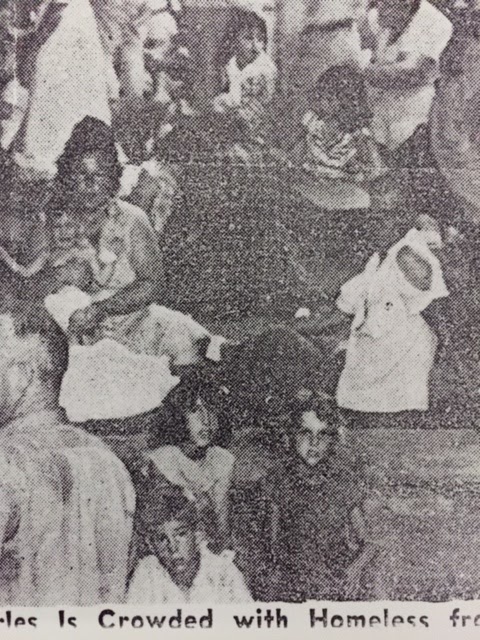


The photo left is from a New Orleans newspaper, snapped at the arena where we were taken after leaving the courthouse. Mama had told us to look up at the cameraman so that Grandma, who lived in New Orleans, would see it and know that we were alive. 

Pictured are Mom holding my baby brother, Dad to the right of her, me, my sister, and brother up front. 

Wednesday, May 1, 2013

The Nutria

What is a nutria anyway?

Also known as Coypu, the nutria (sometimes called nutria rat) is a rodent. They average ten pounds and look like a cross between a beaver and a rat. They have large rear webbed feet, which makes them good swimmers. They are native to Argentina, but found their way to the states in the 1930s.

They are cute, but I don't think they would make good pets because those large front teeth are three inches long and can penetrate your hand very quickly.

My dad, who was a trapper in the 1940s, said he was trapping for beaver when he caught one of these for the first time. They were rare in Louisiana back then, and their thick hides were worth a "pretty penny." By the 1960's they had become so plentiful in the state, the wetlands began to suffer under their ravenous appetite and wasteful eating habits, along with their high rate of breeding.

 
Nutria have large incisors that are yellow to orange-red on the outer surface.   (Photo from U.S. Geological Survey.)

How did they get so plentiful so fast?

Science Daily says: The biology of the nutria species allows it to reproduce at rapid speed, making it an unwieldy animal to control if released into the wild. A female nutria averages about five young per litter, but can birth as many as 13 at a time. A female can breed again within two days after giving birth, meaning one nutria can have up to three litters per year.

To get a sense of their productivity, 20 nutria brought to Louisiana in the 1930s bred an estimated 20 million animals within two decades, according to a wildlife group in Maryland that tracks nutria data, quoted in a recent report by Louisiana journalist Chris Kirkham.

Although nutria were brought to all parts of the country, said Kirkham's report , warm weather in Louisiana has boosted their numbers. Already under pressure from saltwater intrusion, the marshes also have to deal with the nutria and their voracious appetite for the vital marsh roots that keep wetlands intact.

Did Mr. McIlhenny of Tabasco fame bring them to Louisiana?

For many years, Tabasco sauce magnate E.A. McIlhenny received most of the blame for introducing the rodents from South America to Avery Island in the 1930s. McIlhenny wanted to expand the fur trade in Louisiana at that time, so he brought nutria from South America to his home on Avery Island, the story went. But a hurricane blew down the nutria pen, releasing them into the wild.
The myth held for decades, sometimes perpetuated by family members themselves. Five years ago, a historian hired by the family found records that McIlhenny actually bought the nutria from a St. Bernard Parish fur dealer in 1938. He did eventually set the nutria loose, but not because of hurricane damage, said McIlhenny historian and curator Shane Bernard, quoted in reporter Kirkham's recent newspaper interview.

"I'm confident that all the myth has been stripped away," he said. "Anybody who knows oral history or folklore knows how stories can change when they're passed down from one generation to the next."
(Science Daily)

Nutria rat in the water eating. (Credit: iStockphoto/Per Jørgensen)

What do they sound like?

It is said that after Hurricane Audrey, in 1957, during which many young children were swept away into the marshlands, the cries of the nutria were mistaken for lost babies, crying "mom."

In my book, The Legend of Ghost Dog Island, set in Louisiana in the 1950s, there is mention of the eerie sounds these animals make.


What are the Louisiana People doing to save the Marshes from this over-abundant critter?

Check out Nutria Documentary.


Tuesday, January 17, 2012

Hurricane Audrey

from Stories of Bayou Life
Hurricane Audrey, 1957, Cameron, Louisiana.


Water and more water

 It was June of 1957. We had evacuated to the one building in town that seemed sturdy enough to withstand the winds and water that were quickly coming ashore the small southwest Louisiana town.

 The water came in, not with a crashing blow, but swiftly and with purpose, lifting houses from their foundations, ripping propane tanks from their anchors, and shooing people from their homes like they were mere ants. And the water kept coming.

 Houses floated by with people on the roofs, shouting for someone to help them. People floated by on mattresses, waving and crying. No one in our building could help them. We had no way to reach them from the third floor where we were all stranded at the mercy of Mother Nature…or God.

 It would be 24 hours before the water receded, leaving an unimaginable pile of mud, upside down houses, cars parked on top of each other, and even boats in trees. We were still stranded, as power lines lay like one of those games kids played on the school ground, where they made designs between their fingers with a piece of string.

 Food was brought in by men that were brave enough to go out and loot the demolished grocery stores. We finally  had something in our stomachs, since we’d arrived with no thought of having to bring something to eat, but merely to save our lives.

 Another day passed, when we were herded out of the building like cattle on their way to slaughter, over ramps that had been placed over the debris for our safety.

 It would be a long time before the town of Cameron, Louisiana would repopulate, and the citizens that survived there in 1957 would get back on their feet. But come back they did, with only the help of family and friends, they came back strong.